


Sunday 31 May 2026
Last update on Sunday, May 31, 2026 At 8:46 AM
A historic trade hub and Mediterranean gateway to the Levant and the Arabian Peninsula, Lebanon could benefit from the regional realignments brought about by the closure of the Strait of Hormuz. Several initiatives led by the Lebanese authorities attest to their desire to reposition the country at the heart of regional corridors for goods, energy, and digital data.
These projects are part of an intense diplomatic sequence marked by increased high-level contacts with neighboring countries. Prime Minister Nawaf Salam notably traveled to Damascus on May 9 to strengthen bilateral cooperation with Syria, while Energy Minister Joe Saddi visited Cairo on May 6 for discussions with Egyptian authorities on energy issues and regional infrastructure.
Furthermore, on February 25, President Joseph Aoun expressed his desire to include Lebanon in the India-Middle East-Europe Economic Corridor (IMEC), during the visit of Gérard Mestrallet, the French President’s Special Envoy for IMEC.
While Lebanon suffers from a structural electricity production deficit, compensated for by costly and polluting private generators, recent regional agreements reached by the country aim to reduce this dependence.
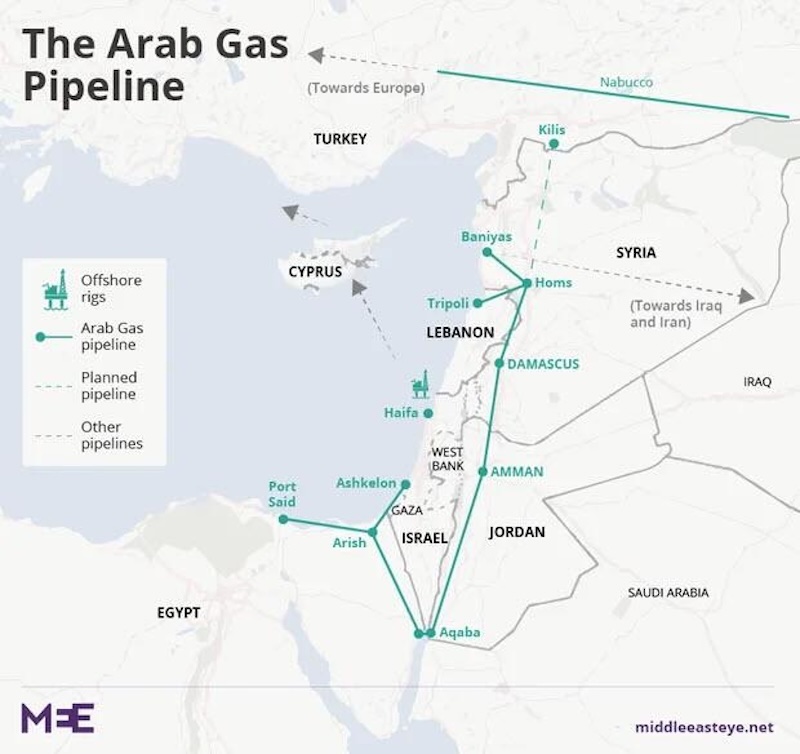
On May 6, Egypt announced its intention to finance the rehabilitation of the Lebanese section of the Arab Gas Pipeline, a 1,200 km pipeline built in the early 2000s connecting Egypt to Lebanon via Jordan and Syria. Led by the Jordanian-Egyptian joint venture Technical Company for Gas Pipeline Operation Services (TGS), the project, which involves laying nearly 30 kilometers of pipeline from the Syrian-Lebanese border, will supply the Deir Ammar gas field in northern Lebanon. Lebanon plans to build a new 825 MW power plant there, alongside the existing 425 MW unit. In parallel, Lebanon, Syria, and Jordan announced a partnership in May to facilitate gas flows between the three countries, based on a gas swap agreement. Gas exported by Jordan, imported as LNG and then regasified in Aqaba via a floating production unit, would be destined for Lebanon but absorbed by Syria. Syria would then deliver an equivalent quantity of gas from its gas fields in the northeast of the country to Lebanon.
In addition, Lebanon also intends to leverage regional interconnections to improve its electricity supply.
In the east, while the World Bank has granted Syria a $146 million subsidy to finance the construction of a power transmission line between Turkey, Syria, and Jordan (the SEEP project), the Arab Fund is simultaneously exploring, through a feasibility study, the possibility of extending the line from Syria to Lebanon. In the north, discussions have begun with Turkey to connect the country, which has a surplus of electricity production, to Lebanon via a line running along the Syrian coast.
In the west, a multilateral donor has committed to financing feasibility studies for a maritime power interconnection between Lebanon and Cyprus, which would extend the Euro-Asia Interconnector high-voltage transmission line linking Greece, Cyprus, and Israel. Lebanon could thus eventually be connected to the European electricity grid.
To support its reconstruction and facilitate the flow of goods to Syria, Lebanon is also initiating logistical projects toward its neighbor.
On May 15, the Ministry of Public Works and Transport announced the launch of a tender for a feasibility study on the rehabilitation of the railway line linking Tripoli to the Abboudiyé border crossing on the Syrian border. Built in the early 20th century, this approximately 40-kilometer line, which was part of the coastal network connecting Lebanon to southern Turkey, has been out of service since the start of the civil war in 1975.
The project carries significant symbolic weight. It would constitute the first railway network built in Lebanon since the end of the civil war and aims to connect the port of Tripoli and its future special economic zone to regional transport corridors. Ultimately, the René Moawad Airport in Qleyaat, north of Tripoli, where the Ministry launched the conversion of the military infrastructure to civilian use this week, and which is located on the railway line’s route, would also serve as a multimodal air-rail hub. Finally, the port of Beirut itself is engaged in developing a master plan that will include a link with Damascus via the Bekaa Valley.
The country also seems determined to reduce its Digital fragility.
Lebanon is connected to the internet only through two submarine cables, Cadmos and Imewe, which constitutes a significant vulnerability in the event of shocks. While it was not among the twenty or so landing points of the Medusa cable, linking a dozen countries bordering the Mediterranean, the Council of Ministers approved Lebanon’s connection to the European initiative in January.
While these initial steps represent concrete progress, Lebanon will need to move beyond an approach focused solely on its domestic needs to position itself as a true regional hub while simultaneously developing its domestic infrastructure.
While Iraq, whose oil exports are disrupted by tensions affecting the Strait of Hormuz, is relying on Syria to ensure the export of its crude oil via the rehabilitation of the pipeline between Kirkuk and the Syrian coastal city of Banyas, Lebanon could also renovate the Lebanese section of this pipeline, which terminates at the port of Tripoli. The country would also benefit from developing a petrochemical plant to refine some of the oil exported via this pipeline from Tripoli.
Finally, like Syria, which plans to build a 4,500 km national fiber optic network with the SilkLink project, connected to the Medusa infrastructure, in order to position itself as a digital bridge between Europe and the Arabian Peninsula, Lebanon could also strengthen its regional role in data transit.
This is especially true since it would offer an alternative to the Bab el-Mandeb Strait, which concentrates 17% of global internet traffic and 90% of the digital data exchanged between Europe and Asia. To this end, Lebanon will need to accelerate the deployment of its national network, of which only 15% is currently covered by fiber optics.
Source: French Embassy in Beirut



Réagissez à cet article